Every autumn, divers on the Egyptian Red Sea start asking the same question: are the oceanic whitetips back? On 18 October 2026 Egyptian media reported that October is again bringing the oceanic whitetip shark (Carcharhinus longimanus) back to the deep reefs of the Brothers Islands and Elphinstone. This guide covers how to recognise the species, where and when it is seen, why it is Critically Endangered, how to behave in the water and how to plan a trip for the season.
What is the oceanic whitetip shark?
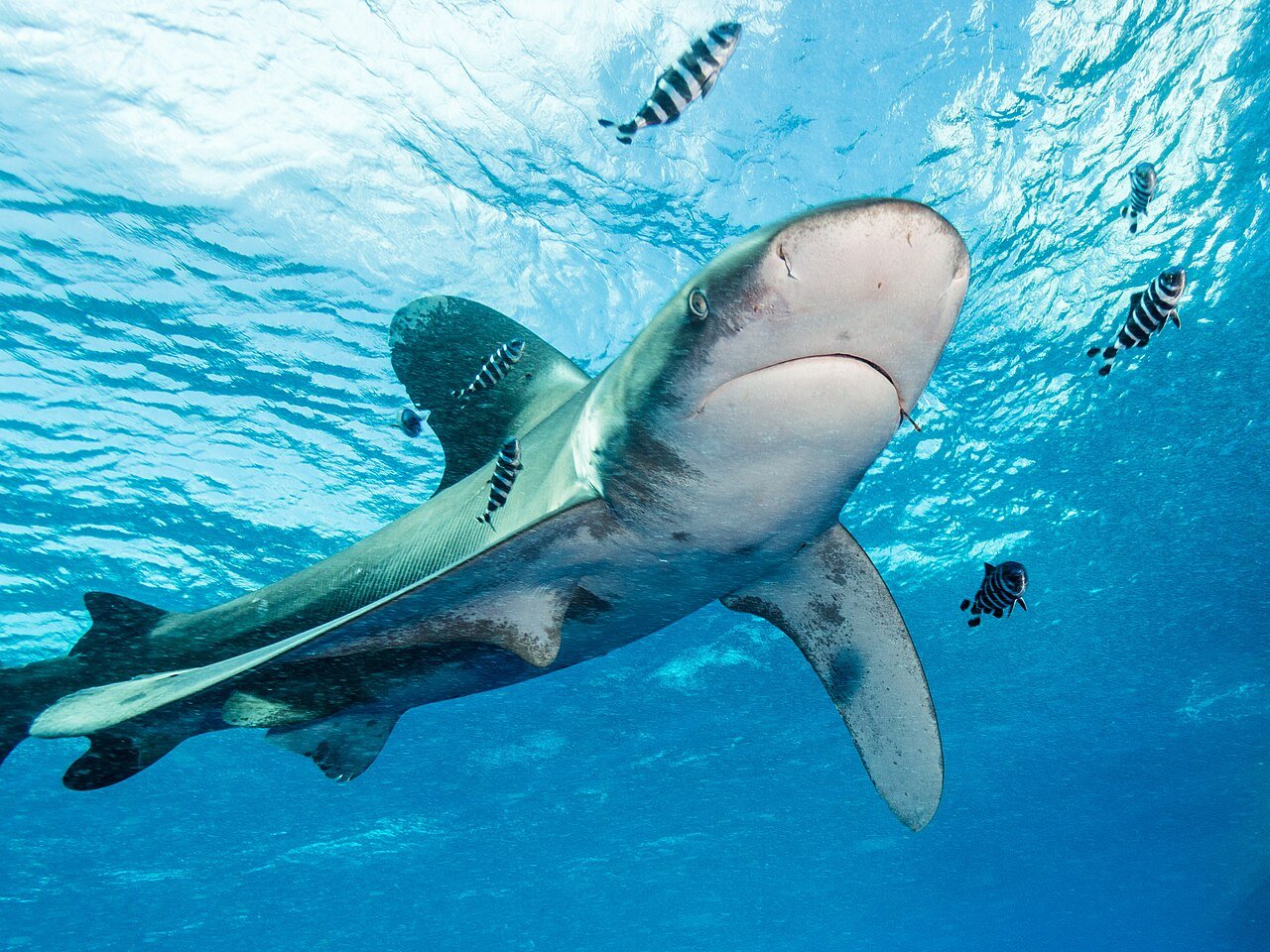
The oceanic whitetip (Carcharhinus longimanus) is a large shark of the open ocean. Its scientific name means “long-handed”, after its long, paddle-shaped pectoral fins. Adults are commonly 2 to 3 metres long. It cruises slowly and steadily, and it is known for being bold and curious: it often comes in close to look at divers and boats, which makes an encounter a thrill and a reason for discipline in the water.
How to recognise an oceanic whitetip
- Long, rounded fins. The pectoral fins are broad and paddle-like, and the first dorsal fin is rounded too, not pointed.
- White fin tips. The tips of the dorsal, pectoral and tail fins carry pale or white patches, which give the species its name.
- Pilot fish. Striped pilot fish often swim just ahead of and below the shark.
- Open-water habit. It patrols the blue beside the reef rather than hugging the wall the way reef sharks do.
What was reported in October 2026
On 18 October 2026 Twasl News Network reported that October marks the start of the autumn season for oceanic whitetips at the Brothers Islands and Elphinstone. It quoted Ahmed Ghallab, general manager of the Red Sea protected areas, who described the species by its long, white-tipped pectoral fins and said it moves widely up and down the water column following food and currents. A change in sightings, he explained, can therefore reflect migration routes rather than a fall in numbers. The report gave no counts or sighting dates. We summarise it in our news item.
Where and when to see oceanic whitetips in Egypt
Oceanic whitetips are seen on deep offshore reefs that rise from open water. In Egypt, divers watch three places. Autumn, starting in October, is the season highlighted in the report, but no site and no date guarantees a shark, and one can be absent for days.
- Elphinstone Reef, Marsa Alam. An offshore reef dived on boat trips from Marsa Alam, so it is the usual way to try for one without a liveaboard. Read our complete Elphinstone guide.
- The Brothers Islands. Big Brother and Little Brother lie far out in the Red Sea and are normally dived from a liveaboard.
- Daedalus Reef. Another remote offshore reef on the classic liveaboard routes, covered in our guide to the Fury Shoals, Daedalus and Brothers routes.
Is the oceanic whitetip dangerous?
It is a large, curious predator and it deserves respect. Most encounters end with the shark simply cruising past, but this is a species that comes in close, so how you behave matters. Our wider answer on sharks and safety is in Are there sharks in the Red Sea? These are the simple rules for the water:
- Keep your distance, and stay with your group and your guide.
- Avoid sudden movements and keep breathing calmly.
- Never chase, touch or feed the animal, and never surround it.
- Keep the shark in view while it passes, and stay close to the reef or the line.
- Follow the briefing for the ascent and safety stop closely, because on these reefs it often happens in open water.
A Critically Endangered shark
The IUCN lists the oceanic whitetip as Critically Endangered. Overfishing, bycatch, the shark-fin trade and climate change are among the threats, and its numbers have fallen sharply across the world’s oceans. That is why a sighting at Elphinstone or the Brothers is something to protect, not just to photograph: the rules above keep both the diver and the shark safe.
Which diver level do you need?
Elphinstone, the Brothers and Daedalus are offshore sites with depth and often current. Boats usually ask for the Advanced Open Water level and a number of logged dives, and the exact requirement is set by each operator and trip. If you are not there yet, the Advanced Open Water course is the natural next step, and a Deep Diver specialty adds confidence at depth. Our Advanced Open Water guide explains what the course covers.
Plan your trip for the season
There are two practical routes. A boat trip to Elphinstone from Marsa Alam fits into a few days of diving, while a liveaboard also reaches the Brothers and Daedalus. Compare them in our liveaboard and day-boat explainer and check the month-by-month Red Sea guide for conditions.

Quick answers
Can I see an oceanic whitetip on a day trip?
Elphinstone is dived on boat trips from Marsa Alam, so a sighting is possible without a liveaboard, but it is never guaranteed on a given dive.
Is October the only month to see one?
Autumn is the season highlighted in the report and by divers, but we cannot promise a sighting on any date, and the animals move widely.
Source: report by Twasl News Network, 18 October 2026. Cover photo: “Oceanic whitetip shark at Elphinstone Reef” by Alexander Vasenin, licensed CC BY-SA 4.0 via Wikimedia Commons.